Explore Hub: Futures and Leverage
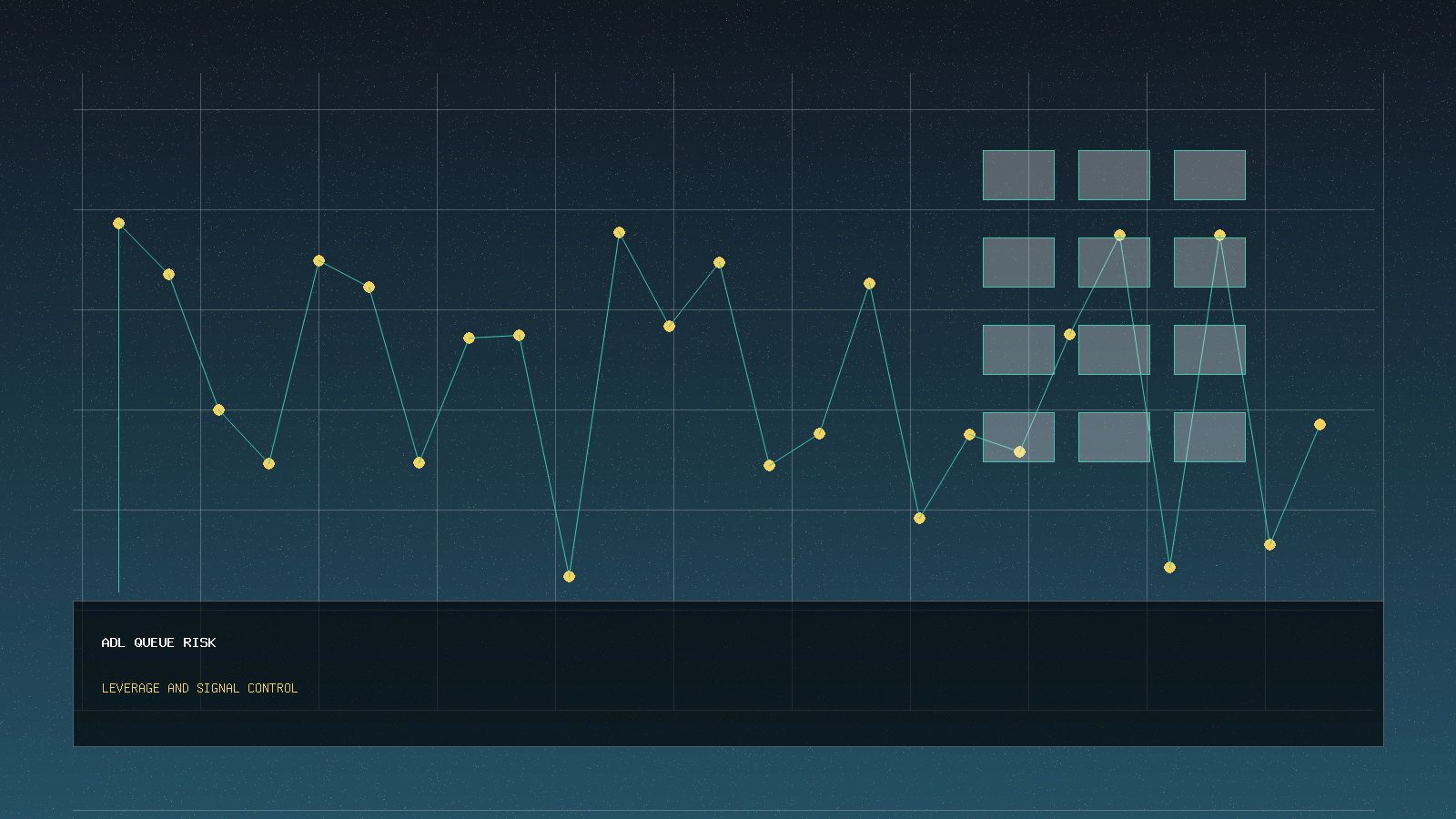
ADL queue risk before high-leverage crypto signals is one of the checks traders ignore until volatility makes it visible. Auto-deleveraging is an exchange mechanism for reducing risk when bankrupt liquidations cannot be fully absorbed by the insurance fund or normal liquidation flow. Most days it sits in the background. During violent futures moves, it becomes part of execution risk.
For CryptoSigy, the useful question is not whether ADL is scary in theory. It is whether your signal size, leverage, stop plan, and exchange venue still make sense when the ADL indicator starts moving against your side of the book.
What the ADL queue tells you
Many futures venues show an ADL indicator or ranking that estimates how exposed your position is to auto-deleveraging. The exact design varies, but the signal is usually tied to profit ranking, leverage, and side imbalance. A higher queue position means the account is closer to being selected if the system needs to deleverage profitable opposing positions.
The key point is that ADL risk is not only about being wrong. A trader can be directionally right and still face forced reduction if the venue is under stress. That is why ADL belongs in the execution checklist beside funding, mark price, liquidation distance, and order-book depth.
This also makes venue choice part of signal quality. Two exchanges can show the same chart setup while carrying different insurance-fund depth, liquidity, risk-limit rules and ADL indicators. A signal that is reasonable on one venue may be too fragile on another if the mechanics around liquidation are already stressed.
Why high leverage makes signals fragile
High leverage compresses the room between a valid idea and a forced outcome. A signal that has a clean chart invalidation may still be poorly structured if the liquidation distance is too close or the ADL queue is already elevated. The setup becomes more dependent on exchange mechanics than market thesis.
Crowded trades are especially vulnerable. If open interest is high, funding is stretched, and the move is already one-sided, the next candle may not give a clean exit. ADL queue risk is a warning that the venue may be carrying too much imbalance for aggressive sizing.
Use ADL as a cancellation filter
ADL does not need to cancel every trade. It should cancel trades where the expected reward is small relative to exchange stress. If the edge requires maximum leverage, tight liquidation distance, and a clean exit during a crowded move, the signal is not robust enough.
The better approach is to lower leverage, reduce size, use isolated risk, or wait for funding and open interest to reset. A missed signal is cheaper than a forced reduction or liquidation event that was visible before entry.
ADL can also change how you manage winners. When a position is profitable but high in the queue, it may be better to take partials earlier, move to reduce-only exits, or avoid adding into the same side. The goal is not to predict the exchange mechanism perfectly; it is to stop a winning trade from becoming dependent on a stressed venue.
A practical pre-trade routine
Before taking a high-leverage signal, check ADL indicator, liquidation distance, mark-price behavior, funding, and whether the exchange has recent incident or risk-limit notices. If two or more checks are stressed, the trade should be smaller or skipped.
After entry, journal whether the trade was managed by thesis or by venue stress. If your decision-making becomes mostly about avoiding liquidation mechanics, the original signal size was too large for the market state.
A good journal note separates the chart idea from the exchange constraints. Write down whether the invalidation was technical, liquidity-based, funding-based, or ADL-based. Over time, this shows whether certain venues, pairs or leverage ranges are creating avoidable execution drag.
- Reduce leverage when the ADL indicator rises before entry.
- Avoid crowded continuation signals when funding and open interest are stretched together.
- Use isolated risk for experimental futures signals with uncertain venue stress.
- Cancel signals that require perfect exchange behavior to remain profitable.
Continue this cluster
The liquidation-and-stop-execution cluster focuses on futures mechanics that can turn a good signal into bad account risk.